The Diagonal Gap in Padel: Why One Up and One Back Loses Points
Padel is played as a pair, in a line. The moment that line breaks, a diagonal corridor opens between you and your partner, and it is the easiest space on the court to exploit.
It usually happens by accident. One of you moves forward on a ball, the other hesitates, and nobody says anything. Then the point ends and neither of you is quite sure whose it was.
What the diagonal gap is
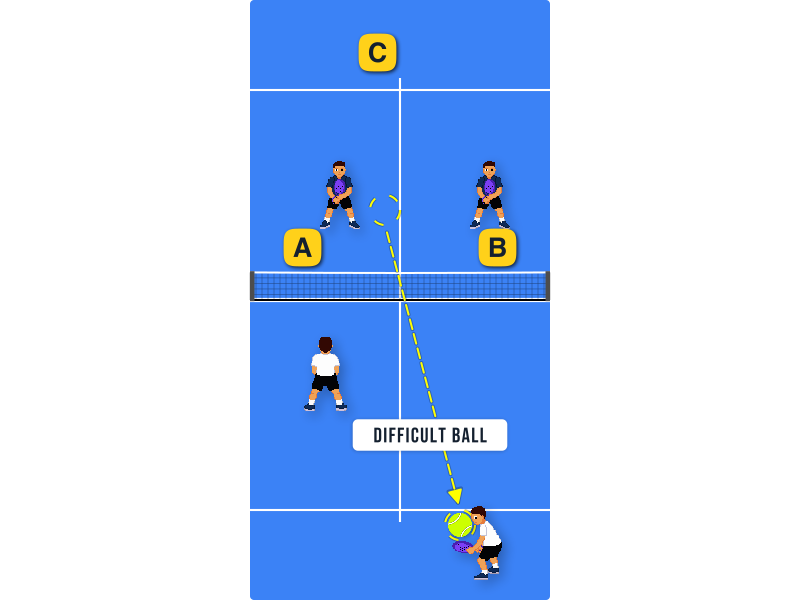
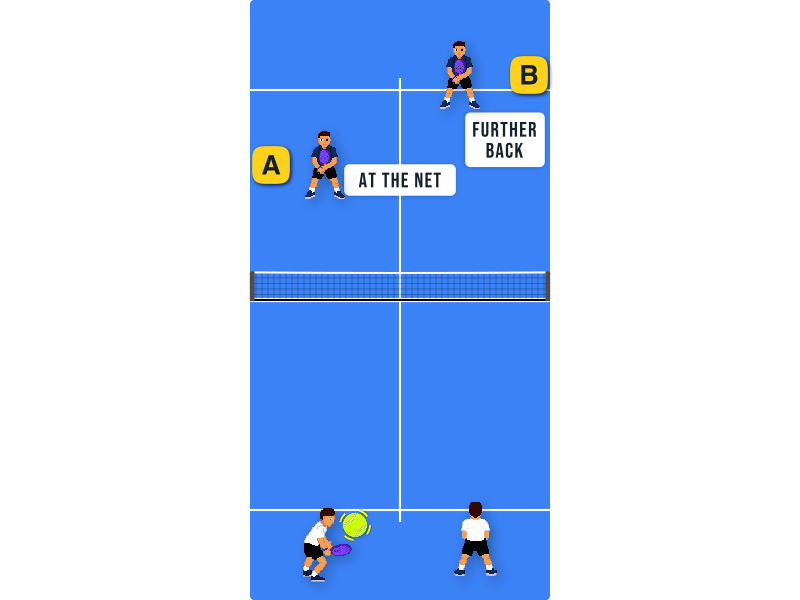
Padel is played as a line of two. When one of you is at the net and the other is at the back, the line breaks and a diagonal lane opens from your opponents through the middle of your court.
It runs past the net player, who is too far forward to reach it, and in front of the back player, who is too far behind to get there. Neither of you is out of position on your own. Together you are.
It is the most common shape in club padel and it costs more points than any single shot does.
They see it instantly
You may not notice the gap. Your opponents will, immediately. From the other side a staggered pair is obvious, and the lane between you is the first thing they look for.
It does not even take a good shot. A simple volley through the middle of that diagonal beats both of you, because the player at the net is past it and the player at the back cannot get across in time.
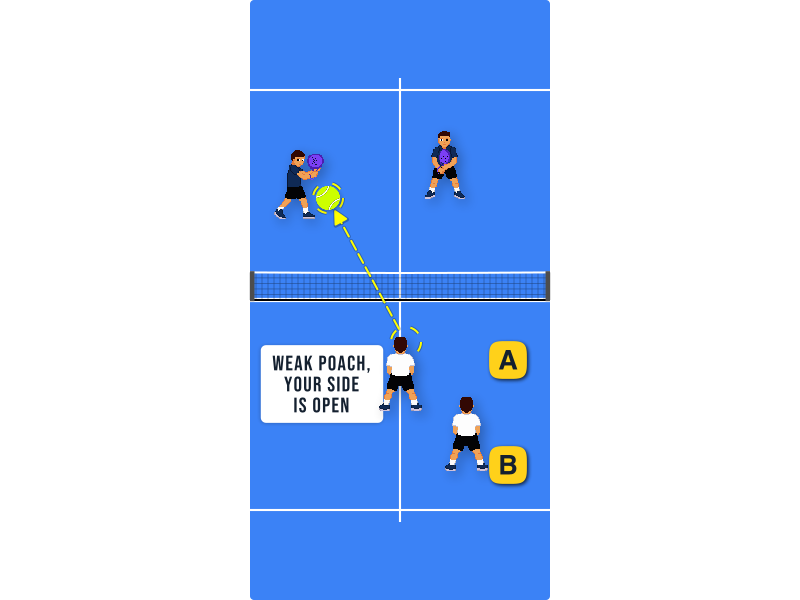
Good opponents do not even have to look for it. They see a broken line the moment it appears and the ball goes there on the next shot, usually before you have registered that your partner moved.
Why it feels safe at the time
Nobody chooses this on purpose. It happens because each player is making a sensible decision for themselves.
One of you got lobbed and dropped back, which was correct. The other stayed at the net because giving up the net feels like losing something, which is understandable. Two reasonable choices produce one broken formation.
That is why it is hard to fix by thinking harder in the moment. It is fixed by agreeing in advance that the pair moves, not the player.
Under pressure, retreat together
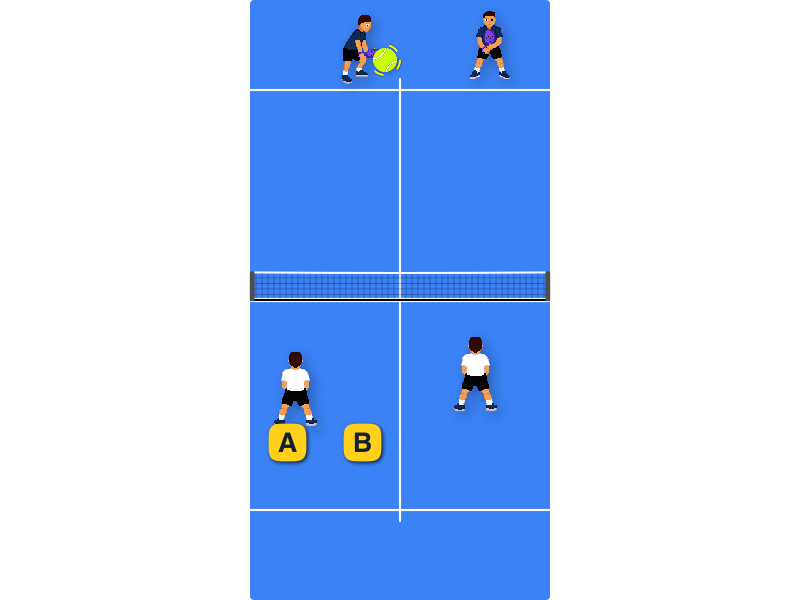
If they have you under pressure, the answer is not for one of you to hold position and hope. Both of you go back.
Two players side by side at the back is a solid defensive shape. There is no lane between you, and you can wait for a ball worth attacking.
Retreating together is the hard one, because the player at the net has done nothing wrong and is giving up a good position. Do it anyway. A net player alone is not an advantage, it is a target with a hole behind them.
On the attack, go up together
The same rule applies in the other direction. When the ball lets you attack, you move forward as a pair.
Side by side at the net, the lane is closed and you cover the court between you. One of you at the net alone is not an attack, it is a target.
The same applies going forward. If your partner earned the net with a good lob, you go with them even if your own last shot was ordinary. Arriving late is still arriving as a pair.
If your partner goes up, you go up
This is the habit that fixes it in real matches. The moment your partner commits forward, you go with them. Do not wait to see how their shot turns out.
Admiring the play from the baseline is what creates the gap in the first place. Their move is your cue, not a decision for you to evaluate.
How to get back in line
If you find yourselves split mid point, the answer is almost always to buy time rather than to sprint. The back player lobs, deep and high, and both of you use the flight to reunite.
Where you reunite depends on the lob. A good one and you both come forward. A short one and you both stay back and defend properly, which is a far better outcome than one of you standing at the net waiting to be smashed at.
The decision is not net or no net. It is together or apart, and together wins even from a worse part of the court.
Move as one line
Both back or both up. There is no third shape that works, and the in-between is where the free points come from.
You do not need to be quick to close the diagonal gap. You need to be together.
The habit to build
Stop thinking of the net as somewhere you personally get to stand. It is a position the pair occupies, and you take it or leave it together.
The quickest way to fix this in your own play is to watch your partner rather than the ball for one shot each rally. If they moved and you did not, the gap already exists, and it will be found within two shots.