Net Positioning in Padel: You Can Only Cover Two of Three Areas
Every player who gets passed at the net has the same private thought: I should have got that one. Then the next ball goes to the other side and they think it again.
Here is the part nobody says out loud. From the net you cannot cover all three areas at once. It is not a fitness problem or a reading problem, it is geometry. The actual skill is choosing which area to leave open on purpose.
Where to stand at the net
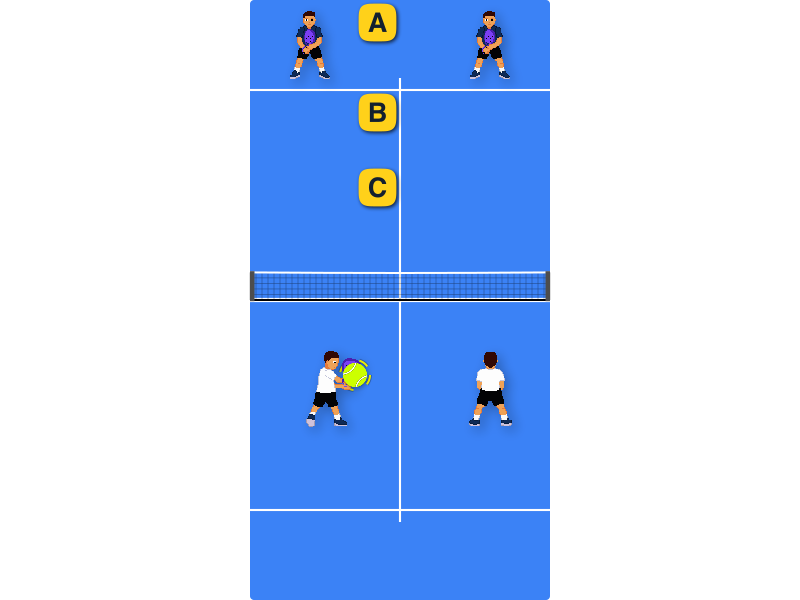
Start with the position itself, because most net problems are really position problems. The attacking spot is roughly 3 to 4m back from the net, not pressed up against it.
Standing right on the net feels aggressive and is the easiest thing in padel to punish. Any lob goes over you, and you have no room to turn and run. From 3 to 4m you can still step in on a low ball and still recover a lob over your head.
That is the base. Everything below is about what you can and cannot reach from it.
You cannot cover all three
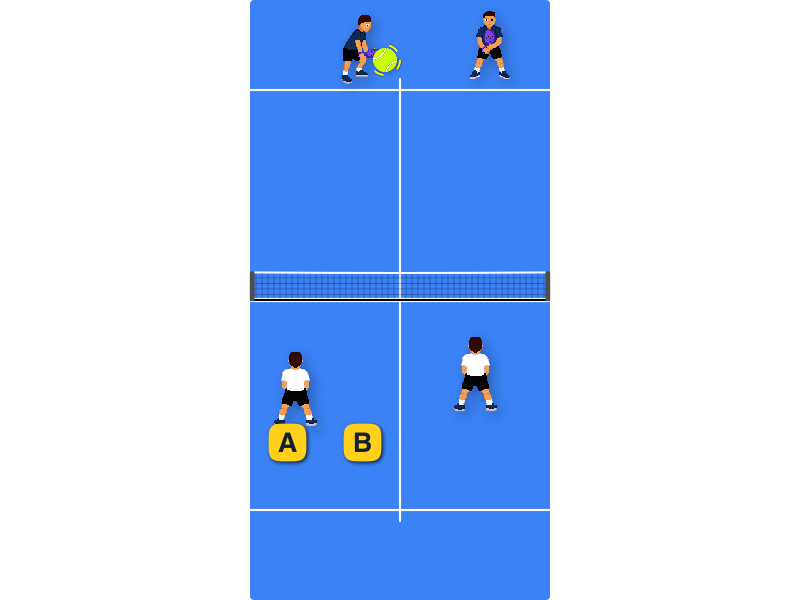
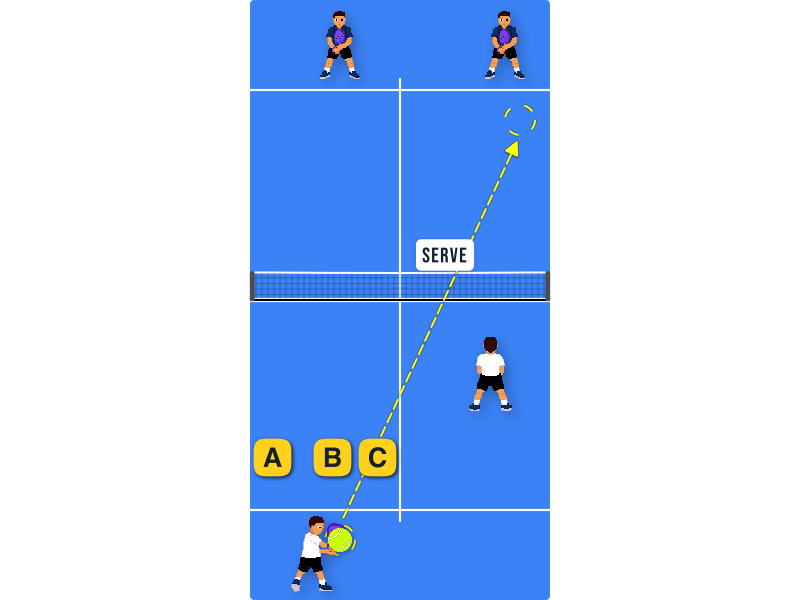
From the net there are three balls available to your opponents: down the middle, parallel down your side, and crosscourt away from you.
The court is 10m wide and your reach with a step is maybe 2 to 3m of it. The arithmetic does not work. Whatever you do, one of those three is open, and pretending otherwise is what makes players drift back and forth covering nothing properly.
So the question is never how to cover everything. It is which one you choose to give away.
Never leave the middle open
The middle is the shortest route past you and the easiest ball they can hit. It needs no angle, no fine margin and no nerve. Anyone can play it, on any day, under any pressure.
So it is never the one you sacrifice. Leave the middle open and you have invited the highest percentage shot on the court.
The middle is first because it is the shortest route past you and the easiest ball for them to hit. It needs no angle and no risk, so it is the shot they will take every time you offer it.
Do not leave the parallel open either
The parallel line down your own side is the next most dangerous. It is short, it is fast, and if you have drifted towards the middle it is simply sitting there.
Leave it open and the gap becomes too big to recover, because you are moving sideways while their ball travels in a straight line.
The parallel is the second priority because it is short too. Down your own side the ball has barely any distance to cover, so even a moderate shot arrives before your partner can rotate across to help.
So cover the middle and the parallel
That leaves one answer. Take the middle and the parallel, and accept that the crosscourt is available to them.
This feels wrong the first few times. You are consciously leaving part of the court unguarded. But you were always going to leave one open. The only question was whether you chose it or discovered it.
In practice this means standing slightly toward your own line rather than in the centre of your half, close enough to the middle to step across but not so far that the parallel is a free lane. Exactly where that lands you changes with every return, which is what net movement covers.
Why the crosscourt is the right one to give
The crosscourt is the longest ball on the court, so it takes the most time to arrive. That time is yours: you will reach far more of those than you expect.
It also carries the finest margin. It has to pass over the highest part of the net and stay inside the furthest corner, so plenty of them simply go out. And even when one lands, they had to play a low percentage shot to win a single point. Let them keep trying it.
It is also the shot that takes longest to arrive. Even when they hit it well, the extra distance buys your partner the time to be there, which is not true of the middle or the parallel.
It changes when they start lobbing
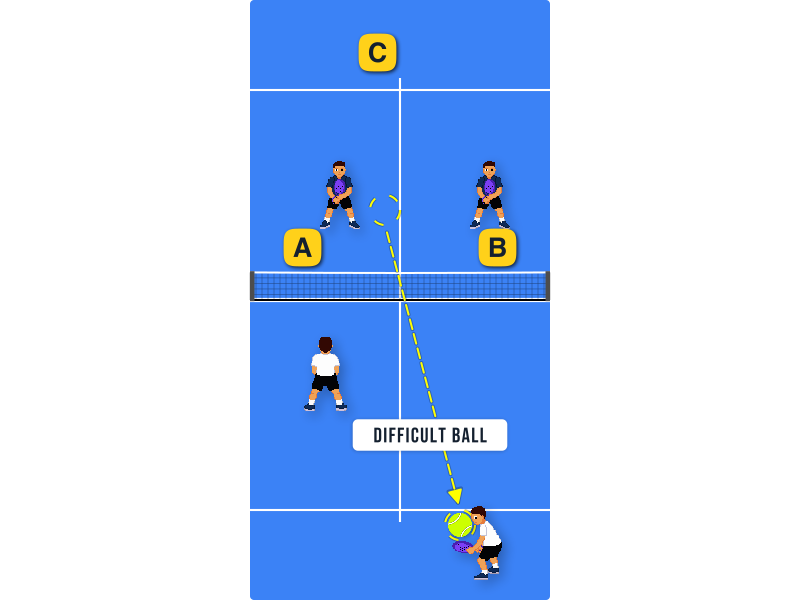
Against a pair that lobs constantly, the calculation shifts, and answering the lob itself becomes its own subject. You hold the same 3 to 4m position but your weight sits slightly further back, and you accept a little less reach forward in exchange for being able to turn and cover the ball over your head.
That is not retreating. It is answering the shot they are actually playing rather than the one you were prepared for.
Both of you make the same choice
This only works if your partner is doing the same arithmetic. If you protect the middle and they also protect the middle, the two parallels are open. If you both cover your own line, the middle splits you.
One of you takes the middle, the other takes their line, and you shift together as the ball moves. Two players covering the same ball is the most common way a pair leaves a hole they never see. The other is one of you at the net and the other at the back, which opens the diagonal gap.
Choose the gap instead of finding it
Good net players are not covering more court than you. They have decided in advance which door to leave open and made sure it is the one that costs the least.
Middle and parallel shut, crosscourt open. When they finally hit the winner down that line, it took their best shot to do it.
What it looks like when it goes wrong
Standing dead centre in your half. It feels balanced and it covers neither the middle nor the line properly, which is the worst of both.
Chasing the crosscourt. You were always giving that one away, and going after it opens the two shots you were meant to be protecting.
Freezing after the first volley. The right position for the next ball is rarely the position you volleyed from.