No Man's Land in Padel: Why You Keep Losing Points in the Middle
There is a strip of a padel court where nothing good happens. It runs across the middle of your half, roughly around the service line, and it is where most club players spend most of their time.
It is called no man's land, and standing in it is not a small positional inaccuracy. It is the reason a lot of points end without you ever getting to play a real shot.
What no man's land is
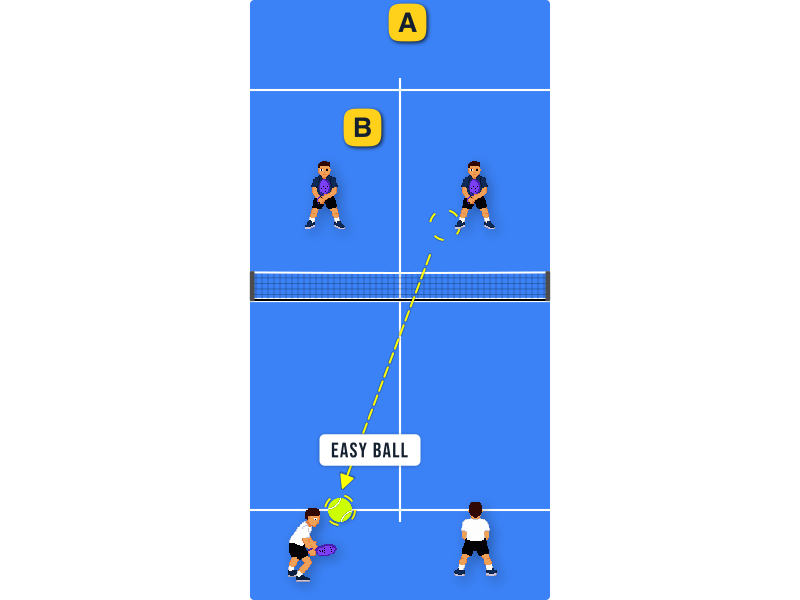
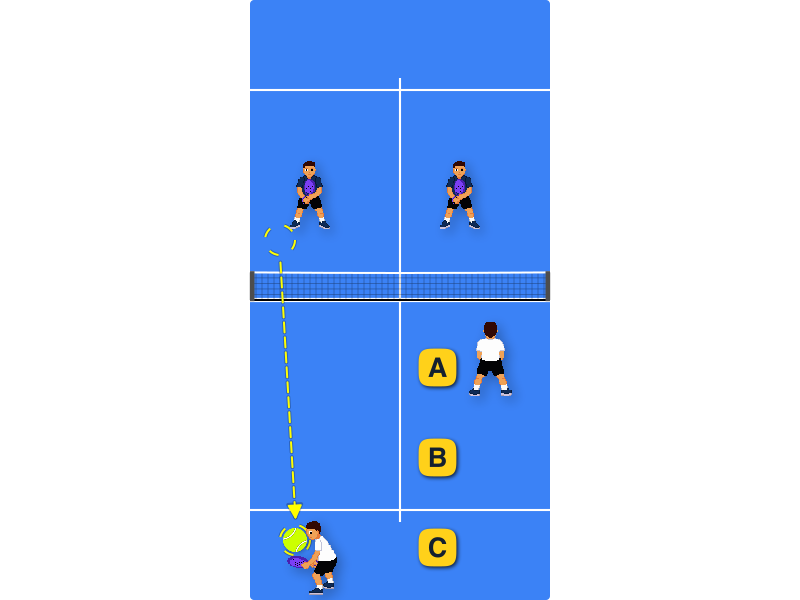
Your half of a padel court is 10m deep. The attacking position sits about 3 to 4m from the net, and the defensive position sits behind the service line, near the back glass. Those are the two real places to stand, and each zone of the court asks something different of you. No man's land is everything in between, the band around the service line where you belong to neither.
Some coaches call it the swamp, others the Bermuda rectangle. The names are different and the complaint is the same: it is a place you pass through, not a place you stand.
Why it is the worst place on the court
It is not that the position is slightly suboptimal. It is that every tool you have is out of reach at once.
You are too far from the net to volley, so balls arrive below net height instead of above it. You are too far forward to use the back glass, so a hard ball past you is simply gone. And you are too far forward to let the ball bounce and take your time, because it bounces at you rather than in front of you.
At the same time you cannot pressure anybody. You are not close enough to the net for your shots to threaten, so your opponents get to play their game with no urgency at all.
They will find you there immediately
This is not a subtle weakness that good opponents slowly work out. It is visible from the other side of the court the moment you stop moving.
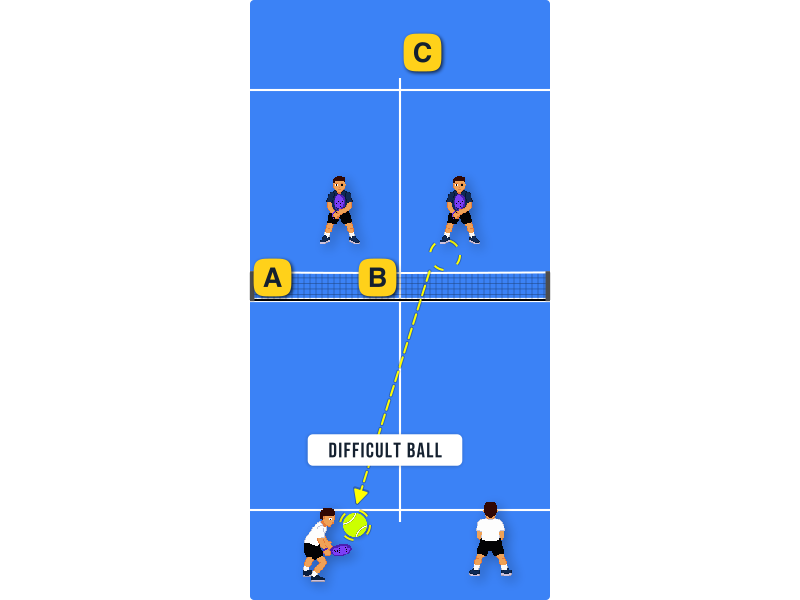
The answer is always the same: hit at your feet. It requires no accuracy and no power, just a ball driven low into the space you are standing in.
You then have to play a half volley at ankle height while moving, which is one of the hardest shots in padel, and you have to do it with two opponents at the net waiting for whatever comes back.
The ball at your feet
Here is the shot itself. Low, into the space between your knees and the floor, with nowhere to swing and no time to move.
Even played well, the best available answer is a defensive scoop that sits up. Played normally, it goes into the net or floats back for a smash. The point was decided by where you were standing, not by how well you struck it.
And that is the point gone
Miss, or return something weak and get smashed on. The outcome varies, the cause does not.
What makes this expensive is that it repeats. If you drift into that band as a habit, you are not losing one point to it, you are losing a version of the same point several times a set.
The fix: commit to one end
There are only two legitimate places to be. Behind the service line, defending properly with the glass available to you. Or 3 to 4m from the net, volleying and applying pressure.
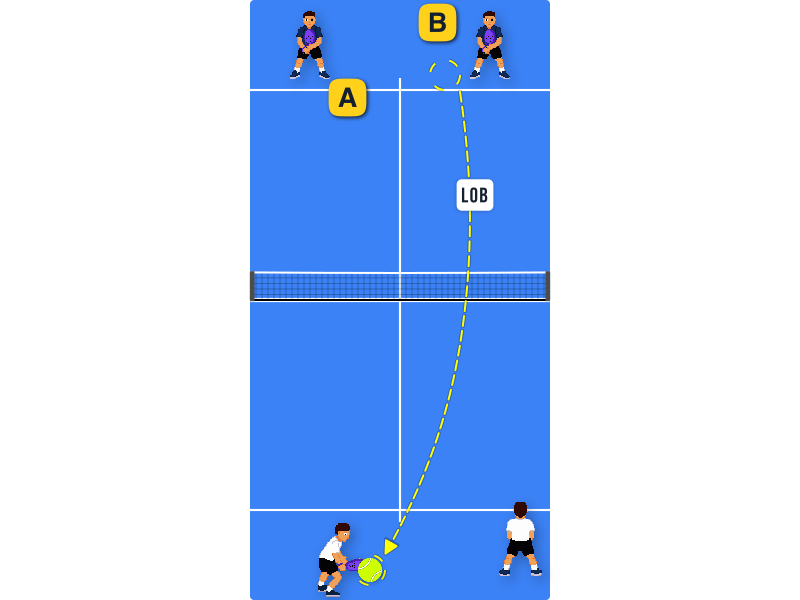
So the rule is short: pick one. If the ball you just played was good enough to move forward on, go all the way forward. If it was not, go all the way back. What you must not do is stop halfway because you are undecided.
Being in the wrong one of those two positions is a small mistake. Being between them is a large one.
Why players end up there anyway
Almost nobody chooses no man's land. They drift into it, and it happens in two ways.
The first is going forward and stopping early. You hit a decent lob, start moving up, then get nervous halfway and plant. The second is retreating and not going far enough. You get lobbed, backpedal a few steps, and settle just in front of the service line rather than behind it.
Both come from treating the movement as optional once it has started. The court punishes half-finished movement much harder than it punishes the wrong decision made fully.
Passing through is fine, stopping is not
None of this means you never enter that part of the court. You cross it constantly, and every approach to the net goes through it.
The difference is that you cross it while the ball is travelling away from you, and you split step at the far end. What you never do is receive a ball while standing in the middle of it.
If you find yourself there as your opponent is about to hit, you have already made the mistake. The only thing left to do is get low, expect the ball at your feet, and be honest with yourself about how you ended up there.
How to notice it in your own game
You will not spot this in the moment, because it feels like standing still, which never feels like an error.
Use the service line as a checkpoint instead. At the moment your opponent hits, ask where your feet are relative to that line. Clearly behind it or clearly in front of it are both fine. On it is the answer you are trying to eliminate.
A few sessions of that one question does more for most players than any shot they could work on, because it fixes points they were losing without ever knowing why.