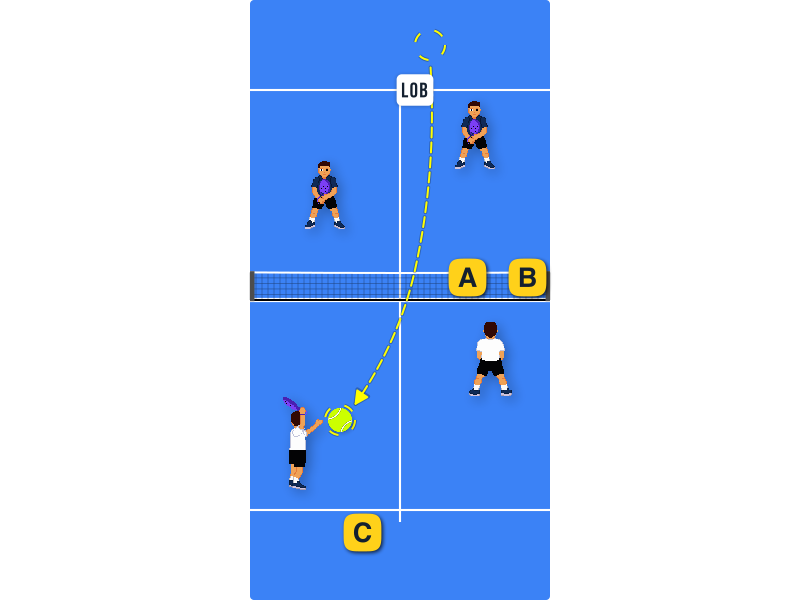
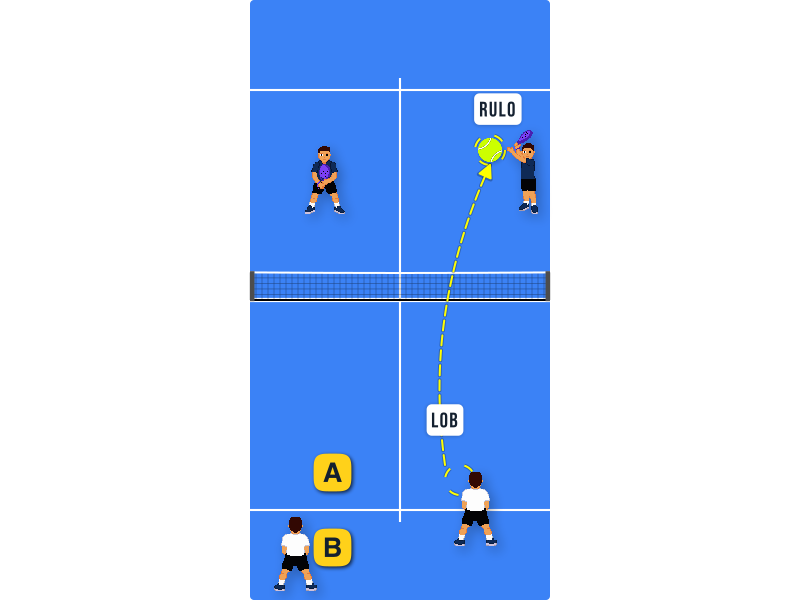
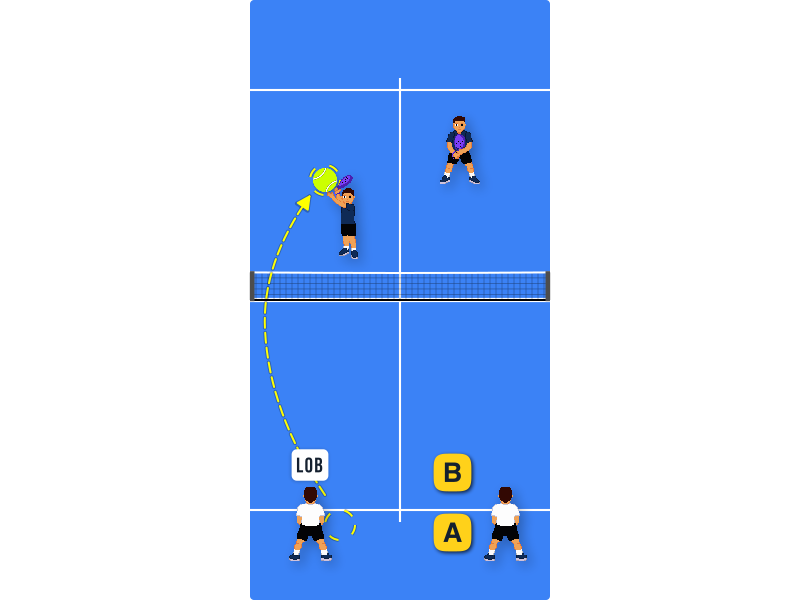
The gancho solves one specific problem: the lob that goes over your weaker shoulder. Instead of turning to hit a backhand overhead, you reach up and hook the ball from above your head with your forehand side, and send it toward the side glass or fence.
Gancho is Spanish for hook, which is exactly the motion. It lets you stay at the net on a lob that would otherwise force you back.
When to play a gancho
The gancho is for the lob that goes over your backhand side when you do not have time to move around it. For a right-hander that is a ball passing over the left shoulder.
If you have time to step around the ball, do that and play a normal bandeja. The gancho is the option for when you are short on time but still want to keep the net.
How to hit it
Keep your shoulders fairly square, take a step back, and reach up so you meet the ball above or slightly behind your head on the non-dominant side.
The racket hooks over the top of your head and across, so the ball goes toward the side of the court. It is a compact swing: a short reach and a controlled push, not a full smash motion.
Stay balanced. The gancho is played with your weight moving slightly back, so do not try to add power you cannot control.
Where to aim
Aim toward the side glass or the fence, so the ball bounces and comes off the side at an awkward angle. That bounce is what stops your opponents from attacking it.
Keep it deep enough that they cannot step in. A gancho that sits up in the middle of the court is an easy ball.
Common gancho mistakes
Using it when you had time to move. If you can get around the ball, a forehand-side overhead gives you far more control.
Swinging too hard. The awkward contact point makes power unreliable, and errors come fast.
Staying back afterwards. You played the gancho to keep the net, so step forward again.
Gancho questions
- What is a gancho in padel?
- A gancho is an overhead hook shot played when a lob goes over your non-dominant shoulder. You reach up and hook the ball over your head toward the side glass or fence, so you can stay at the net.
- What does gancho mean?
- Gancho is Spanish for hook, which describes how the racket hooks over your head to meet the ball.
- Is a gancho the same as a backhand overhead?
- No. A backhand overhead is hit with the back of the racket after turning your back to the net. A gancho is hit from above your head on the forehand side, with the shoulders more square.
- When should I play a bandeja instead of a gancho?
- Whenever you have time to move around the ball. The bandeja gives more control; the gancho is for when the lob is already over your weak shoulder.